True Self Discovery: Build Meaningful Planners and Journals with Ease
Most people don’t wake up one day and instantly know themselves. Self-discovery is a gradual process—one that often benefits from structure, prompts, and a little bit of space to reflect. That’s where True Self Discovery comes in. It’s not just a collection of pages; it’s a framework designed to help you (or your audience) move from surface-level journaling to genuine insight. Whether you’re creating a personal growth planner for yourself or building a product to sell on Amazon KDP, having a set of ready-to-use, editable templates saves time and ensures your content actually guides people toward understanding their strengths, triggers, values, and inner critic.
Let’s walk through what True Self Discovery really is, who uses it, and how it works in real life—no fluff, just practical application.
What Exactly Is True Self Discovery?
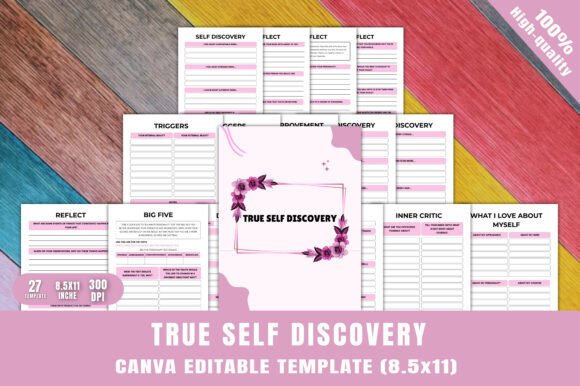
True Self Discovery refers to both the concept and the specific Canva KDP Interior product. Conceptually, it’s the ongoing process of uncovering your authentic identity—your core personality, emotional patterns, natural strengths, and hidden triggers. Practically, this package gives you 27 professionally designed, fully editable pages that prompt reflection on areas like the Big Five personality traits, feelings, triggers, and self-appreciation. The templates come in Canva format, so you can change colors, fonts, layout, and even rewrite prompts to match your brand or personal style. It includes notes pages, a daily check-in (2 pages), reflection pages (10), a feelings wheel, strengths and skills pages, self-discovery prompts, trigger analysis, and that all-important “What I Love About Myself” page.
Because it’s a no-bleed, print-ready PDF (plus JPG and PNG files) at 300 DPI, you can upload directly to KDP or send it to a local printer. It’s designed for 8.5 x 11 inch letter size, so no weird scaling issues.
Who Uses True Self Discovery and Why?
The audience for these templates is surprisingly broad. While it’s obviously a tool for personal journaling, it’s also a practical resource for:
- Entrepreneurs and small business owners creating guided journals for a niche audience (e.g., “Mindful CEO” or “Creative Recovery”).
- Coaches and therapists who want to give clients a structured homework tool between sessions.
- Teachers and educators running social-emotional learning (SEL) programs or career guidance workshops.
- Freelance designers and content creators who need a fast, customizable foundation for a self-reflection product.
- Everyday adults (ages 20–50) who simply want to understand themselves better without reinventing the wheel.
Each group uses the same pages but in different contexts. That’s the beauty of a modular, editable interior: you tailor the experience.
Real Situations Where This Gets Used
Scenario 1: A life coach wants to offer a 30-day self-discovery challenge to clients. Instead of spending 40 hours designing worksheets from scratch, they open the Canva file, duplicate the daily check-in page, add a few custom journaling prompts, change the color palette to their brand, and export a PDF. The time savings alone makes the product worth it—but the real win is that the client gets a cohesive, professional workbook that actually tracks growth over time.
Scenario 2: A blogger runs a website about intentional living. They want to create a freebie opt-in lead magnet that attracts subscribers. They grab the strengths and skills pages, add their logo, adjust the fonts to match their site, and offer “Discover Your Top 5 Strengths” as a download. Subscribers use the page, reflect, and are more likely to buy the premium planner later.
Scenario 3: A hobbyist is going through a tough transition—career change, breakup, or relocation. They buy the interior to use as a personal journal. They don’t change any design; they just print it out and start writing. The triggers page helps them identify patterns, the “What I Love About Myself” page becomes a mood booster, and the feelings wheel helps them name emotions they couldn’t articulate before. This isn’t magic—it’s just a smart layout that prompts specific thinking.
Key Features That Translate to Real Outcomes
It’s easy to list features (27 pages, editable Canva link, etc.), but what do those features actually do for a user?
- Editable Canva file means you control the final look. You can match your brand colors, change the language to work for different demographics (e.g., teen-friendly vs. corporate), or even translate the prompts into another language. This is essential if you plan to sell on KDP in multiple markets.
- Big Five Personality Pages provide a framework for understanding where someone falls on the openness, conscientiousness, extraversion, agreeableness, and neuroticism spectrum. A coach using this can help clients identify career paths that fit their natural tendencies.
- Reflect pages (10 total) are not just empty lines. They include guided questions about recent experiences, emotional patterns, and lessons learned. For someone who doesn’t know “what to write in a journal,” these prompts eliminate the blank-page anxiety.
- Triggers pages force you to list situations that cause stress or reactivity. Recognizing a trigger is the first step to managing it. For a small business owner, this could mean spotting why they procrastinate on certain tasks.
- Strengths and Skills pages go beyond generic “list your strengths” and invite you to think about skills you’ve developed recently, even if they’re not obvious. This is practical for resume building or just feeling more competent.
- Inner Critic Page is designed to externalize negative self-talk. By writing down what the critic says and then questioning it, users build mental space between themselves and their thoughts.
Where and When to Use True Self Discovery
This isn’t a product you buy and forget. It fits into daily, weekly, or monthly routines. Many people use the daily check-in every morning (takes 5–10 minutes) and dive into the deeper reflect pages on weekends or after a significant event. The feelings wheel and triggers pages are best used when you’re in a heightened emotional state—right after a conflict or a big win—because that’s when the data is most accurate.
For creators and publishers, the timing depends on your launch schedule. If you’re building a journal for Q1 (New Year, resolutions, self-improvement), having these templates ready in November gives you two months to customize and test. The product comes as a source file, so you can iterate without starting over.
What to Consider Before Using or Buying
Before you download and start editing, think about your audience or your own goals.
- If you’re a publisher: Check if the prompts match your intended niche. The Big Five personality pages are fairly universal, but if your audience is specifically people recovering from burnout, you might want to add more self-compassion prompts. Because the file is editable, you can adjust, but you need to plan the changes before you duplicate 27 pages.
- If you’re an individual user: Consider how you prefer to reflect. Some people love structured prompts (like “What triggered me today?”), while others need more open space. This interior includes both—the notes pages are blank, and the reflect pages have prompts. Ideally, you’ll want a mix. Print a few samples first to see if the layout feels right.
- If you’re a coach or counselor: Remember that self-discovery tools are not a substitute for professional therapy. Use them as supplements, not diagnoses. The triggers page is excellent for awareness, but you should offer it alongside guidance on how to process those triggers.
- File format compatibility: The editable Canva link requires a free or Pro Canva account. Most people already use it, but if you are strictly offline, you might need to work differently. The included PDF and JPG/PNG files are static—editing requires Canva.
Practical Tips for Getting the Most Out of It
If you’re using this for your own journaling, don’t try to fill every page immediately. Pick one section—say, the feelings wheel for a week—then move to triggers, then strengths. Let the process unfold naturally. If you’re publishing, consider bundling this interior with a companion guide or a cover that reflects deep self-work (think muted colors, natural textures). On KDP, categories like “Journal Writing” or “Self-Help” work well.
For small business owners, you can repurpose individual pages as social media posts. Take a screenshot of the “strengths skills” page and post it as a story prompt for your audience to share their own answer. It engages followers and gives you content that ties directly to your product.
Connecting Features to Real Outcomes
Let’s connect three specific features to outcomes you’ll actually experience:
- 100 customizable source file: You aren’t locked into a rigid design. If you realize your brand uses pastel pinks but the default is teal, you change it in seconds. That means you can test multiple versions on KDP without starting from scratch.
- No-bleed layout: KDP can be picky about margins. With no bleed, you avoid the headache of trimming or getting rejections. Perfect for print-on-demand beginners.
- Multiple file formats: Use the PDF for print, the JPG/PNG for digital planners (GoodNotes, Notability), and the Canva file for further customization. You essentially get three products in one.
The outcome for a busy entrepreneur? Less time fiddling with InDesign or Canva from nothing—more time marketing or serving clients. The outcome for a personal user? A guided path to self-awareness that doesn’t feel like homework.
True Self Discovery is both a concept and a concrete toolkit. If you’ve been meaning to create a structured journal for yourself or for others, but you keep getting stuck on the design or the page flow, this interior removes that barrier. It gives you a strong foundation—then trust your own creativity to make it yours.