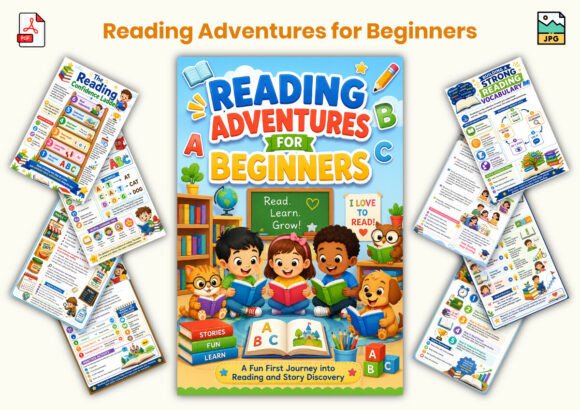
Reading Adventures for Beginners
For educators, parents, and tutors working with early readers, the transition from recognizing letters to decoding words and understanding sentences is a critical milestone. Finding resources that address the range of skills involved—from phonemic awareness to reading comprehension and even goal setting—can be time-consuming. Reading Adventures for Beginners packages these essential components into a single, 31-page workbook designed to guide young learners through a structured reading journey.
Rather than offering isolated worksheets, this resource presents a cohesive learning experience that balances skill development with motivational elements. Whether you are a classroom teacher building literacy stations, a homeschooling parent planning weekly lessons, or a tutor reinforcing foundational skills, understanding the structure and practical applications of this workbook can help you determine if it fits your instructional needs.
A Practical Tool for Building Early Literacy
Reading confidence often comes from consistent, manageable practice. One of the strengths of Reading Adventures for Beginners is its deliberate scope. The 31-page format is long enough to provide meaningful repetition across different skill areas yet short enough to avoid overwhelming a young learner. This balance is particularly useful for building routines—whether it is a daily warm-up activity, a weekly homework packet, or a summer learning supplement.
The workbook integrates several types of activities that work together to support reading readiness:
- Reading strategies and success techniques that teach children how to approach a text
- Comprehension activities that move beyond simple recall
- Vocabulary building exercises to expand word knowledge
- Goal setting and reflection journals that encourage metacognition
- Motivational reading challenges to sustain engagement
For busy adults, having these components in one place eliminates the need to piece together materials from multiple sources. The print-ready PDF and high-quality JPG files mean you can start using the workbook immediately, whether printing a full booklet or selecting individual pages for specific lessons.
Understanding the Design and User Experience
Early learning resources live or die based on their visual design. If a page is too cluttered, young readers become distracted. If it is too plain, they lose interest. The bright cartoon classroom theme used throughout Reading Adventures for Beginners strikes a practical middle ground. The visuals are engaging enough to capture attention but clean enough to maintain focus on the learning task.
The 6 x 9 inch trim size is another thoughtful choice. This format is larger than a pocket notebook but smaller than a standard letter-sized worksheet, making it approachable for small hands. It fits easily into a teacher bag, a tutoring kit, or a child’s backpack for daily practice. The unique layout on each page also keeps the experience fresh, preventing the monotony that can occur when every worksheet looks the same.
From a production standpoint, the inclusion of both PDF and JPG files offers flexibility. You can print the entire workbook as a cohesive unit using the PDF, or you can project individual JPG pages on a screen for group instruction. For digital content creators, this dual format is also an industry best practice, allowing the resource to be used across different platforms and devices.
Key Learning Categories and How They Work Together
A well-designed workbook scaffolds learning by building on previously introduced concepts. Reading Adventures for Beginners organizes its content into several interconnected areas that reinforce one another.
Alphabet and Word Recognition
Foundational reading skills begin with letter knowledge and word recognition. The workbook includes activities that reinforce these basics without relying on rote memorization alone. Instead, the exercises are designed to help children see patterns in words, a skill that supports fluent decoding later on. Whether used as a primary lesson or a quick review, these pages give beginners repeated exposure to high-frequency words and letter combinations.
Vocabulary and Comprehension Practice
Knowing what words mean is just as important as being able to sound them out. The vocabulary comprehension pages in this resource introduce new words in context, helping children connect meaning to print. The comprehension activities go beyond simple questions, encouraging learners to think about what they have read and express their understanding in age-appropriate ways. For educators, this dual focus on vocabulary and comprehension is essential for building strong readers who can engage with texts meaningfully.
Reading Habits, Reflection, and Goal Setting
One of the more notable aspects of this workbook is its inclusion of reflection journals and goal-setting exercises. These pages encourage young readers to think about their own learning—what they enjoyed, what they found challenging, and what they want to read next. While this metacognitive approach is common in upper grades, it is less frequently seen in resources designed for beginners. Introducing reflection early helps children develop ownership of their reading journey, which can build long-term motivation and confidence.
For adults guiding this process, the reflection pages also provide valuable insight into a child’s interests and struggles, making it easier to tailor future instruction.
Practical Applications Across Different Settings
The versatility of Reading Adventures for Beginners makes it suitable for a variety of learning environments. Here are realistic ways different users might implement this resource.
For the Homeschooling Parent
If you are managing multiple children at different levels, having a structured workbook for your emerging reader provides much-needed independence. You can assign a page or two per day as part of a morning basket or language arts block. The goal-setting and tracking pages also serve as a simple portfolio of progress, which can be useful for end-of-year assessments or for building a sense of accomplishment in your child.
For the Classroom Teacher
Classroom teachers often need materials that work for a range of abilities. The 31 pages in this workbook can be used as literacy center activities, early finisher packets, or small group warm-ups. Because each page has a unique layout, students remain engaged, and the teacher can easily differentiate by assigning specific pages to specific students based on their current skill level. The bright classroom theme also aligns visually with many primary-grade classroom setups.
For the Tutor or Interventionist
Time is valuable in a tutoring session. Having a ready-to-go workbook means less prep work and more focused instruction. You can use specific pages as diagnostic tools to see where a student needs support or as reinforcement activities to send home between sessions. The print-ready PDF format is particularly useful here—you can print exactly the pages you need without worrying about formatting issues.
For Digital Content Creators and Educators Evaluating Resources
If you create educational materials for platforms like Teachers Pay Teachers, the structure of Reading Adventures for Beginners offers useful insights into what makes a sellable resource. The clear topic focus, professional design, and inclusion of multiple file formats are all characteristics of a well-conceived product. The 6 x 9 inch trim size, for example, is popular among digital sellers because it balances content density with easy readability on screens and in print.
Evaluating an Early Literacy Resource: What to Look For
When selecting a workbook for a beginning reader, it helps to evaluate it against several practical criteria. Reading Adventures for Beginners holds up well in these areas, but understanding these factors will also help you assess similar resources you encounter.
- Scope and Sequence: Does the resource build skills logically, or is it a random collection of activities? This workbook follows a coherent progression from word recognition through comprehension and goal setting.
- User Engagement: Is the visual design appropriate for the age group? The cartoon classroom theme is bright but not overwhelming, which helps maintain focus.
- Format Flexibility: Can you use the resource in multiple ways? The combination of PDF and JPG files allows for printing, digital display, and even use on tablet devices.
- Prep Time: How much time will you spend getting the material ready? Because this is print-ready, the answer is minimal—a significant advantage for busy educators and parents.
- Licensing and Usage: Always check the terms of use for any educational resource, especially if you plan to use it in a commercial or group setting. The clear file structure here suggests a product designed with professional use in mind.
Practical Considerations for Implementation
To get the most out of Reading Adventures for Beginners, consider how it fits into your existing routine. For a child who is just beginning to recognize letters and sounds, you may want to start with the alphabet and word recognition pages before moving into comprehension activities. For a child who already has some decoding skills, the vocabulary and reflection pages might be a better entry point.
The motivational reading challenges included in the workbook are a useful tool for building stamina. You can pair these with a simple reward system or use them as a way to track progress during a summer reading program. The goal-setting pages are particularly effective when used collaboratively—sit down with the child, talk about what they want to achieve, and check in on those goals regularly.
If you plan to use the workbook in a classroom or tutoring setting, consider printing the pages and assembling them into individual booklets for each student. This makes distribution easy and helps students feel a sense of ownership over their learning. The 6 x 9 inch size is easy to staple or bind, and it stores conveniently in student cubbies or folders.
Ultimately, the value of a resource like this lies in its ability to reduce friction for the adult while increasing engagement for the child. When the activity is ready to go and aligned with learning goals, consistent practice happens naturally. For those seeking a balanced, thoughtfully designed introduction to reading, Reading Adventures for Beginners provides a solid foundation that supports both the teacher and the learner.