Overthinking Detox Prompts: A Practical Tool for Mental Clarity
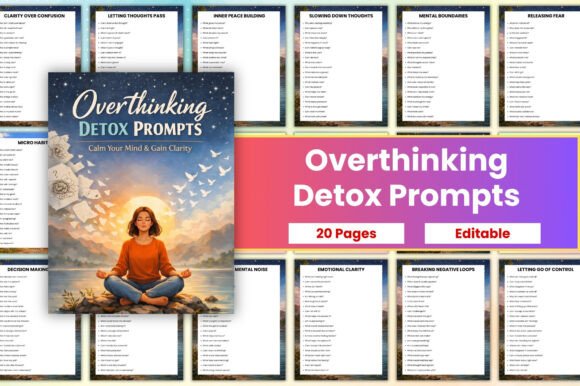
Overthinking can feel like a constant hum in the background of daily life—a loop of repeated thoughts, hypothetical scenarios, and second-guessed decisions. For many, this mental noise interferes with sleep, focus, and emotional balance. Overthinking Detox Prompts is a resource designed to address this challenge directly. It is a collection of guided questions organized around key areas such as thought awareness, letting go of control, breaking negative thought loops, calming the mind, emotional clarity, decision-making, self-trust, reducing mental noise, and building inner peace. Each prompt is structured to encourage reflection without adding pressure, making it a gentle but systematic approach to quieting an overactive mind.
This article explores what Overthinking Detox Prompts offers, who might benefit from it, and how to evaluate whether it fits your personal goals for mental clarity and emotional well-being.
What Overthinking Detox Prompts Provides
At its core, Overthinking Detox Prompts is a journaling tool. However, it differs from a blank notebook or a general gratitude journal because every prompt is intentionally crafted to target specific patterns of overthinking. The prompts cover areas such as recognizing repeating thoughts, examining the need for control, processing emotions without judgment, and building trust in your own decisions. The resource is designed as editable and printable pages, giving you the flexibility to use it digitally on a tablet or computer, or to print pages for handwritten journaling.
The layout is clean and minimal, which supports a calm, distraction-free experience. The prompts are simple but not simplistic—they invite deep reflection without feeling overwhelming. This balance is important because overthinking often comes with a sense of urgency or pressure, and a tool that feels too demanding can backfire.
Why Someone Might Consider This Resource
People typically seek out tools like Overthinking Detox Prompts when they notice that their thoughts are interfering with daily life. Common signs include lying awake at night replaying conversations, struggling to make decisions because of fear of choosing wrong, or feeling mentally exhausted by mid-afternoon. Overthinking is not just about worrying; it often involves perfectionism, rumination, and a difficulty with uncertainty.
If you have tried general journaling but found it too unstructured to help with specific thought patterns, this resource offers a more targeted approach. The prompts guide you to examine not just what you are thinking, but how you relate to your thoughts. Over time, this can help reduce the intensity of mental loops and build a calmer inner environment.
Structured Reflection Without Overwhelm
One of the main advantages of this journal is that it provides structure. Instead of staring at a blank page wondering where to start, you have a clear prompt to respond to. This lowers the barrier to beginning a reflection practice. The prompts are designed to feel manageable—most can be answered in a few minutes, which makes it easier to build a consistent habit.
Targeted Focus on Overthinking Patterns
Unlike general wellness journals, Overthinking Detox Prompts is specifically built around the mental habits that fuel overthinking. The sections on breaking negative thought loops and reducing mental noise are particularly helpful for someone who recognizes their mind tends to spiral. The prompts encourage you to observe your thoughts without judgment, which is a foundational skill for calming anxiety.
Flexibility in Format
The editable and printable nature of the pages means you can adapt the resource to your preferred medium. Some people find handwriting more grounding, while others prefer the convenience of typing on a device. This flexibility reduces friction and makes it easier to stick with the practice.
Supports Emotional Clarity and Decision-Making
Overthinking often clouds emotions and makes decisions feel impossible. The prompts in this collection help you separate facts from fears, clarify what you truly value, and build self-trust. Over time, this can lead to faster, more confident decision-making and less energy spent on second-guessing.
Tradeoffs and Considerations
While Overthinking Detox Prompts is a valuable tool for many, it is important to consider its limitations. Understanding these tradeoffs will help you decide whether it is the right fit for your situation.
Requires Consistent Engagement
No journal or prompt collection works by itself. The effectiveness of Overthinking Detox Prompts depends on regular use. If you are not ready to invest time in daily or weekly reflection, the resource may not produce the results you hope for. Consistency matters more than the specific prompts themselves.
Not a Substitute for Professional Help
This resource is designed for self-guided reflection and is not a replacement for therapy or medical treatment. If you are experiencing severe anxiety, depression, or persistent intrusive thoughts, a mental health professional can provide support that goes beyond what a journal can offer. Overthinking Detox Prompts can be a helpful complement to professional care, but it is not a standalone solution for clinical conditions.
May Feel Repetitive Over Time
Although the prompts cover a wide range of themes, some users may find that after several weeks, the questions feel familiar. This is common with any structured journal. To maintain engagement, you might rotate between sections or use the prompts as a starting point for deeper exploration rather than answering each one only once.
Digital vs. Print Tradeoffs
While the editable digital format offers convenience, some people find that screen-based journaling does not provide the same grounding effect as handwriting. If you are sensitive to screen time or find that digital journaling feels less personal, printing the pages may be a better choice. The resource supports both options, but you will need to decide which medium aligns with your preferences.
Who Is Overthinking Detox Prompts a Strong Fit For?
This resource is well-suited for individuals who:
- Recognize they overthink but feel unsure how to start shifting their mental habits
- Have tried general journaling but want more structure and focus
- Are looking for a low-pressure way to build self-awareness and emotional clarity
- Prefer a tool that can be adapted to both digital and print formats
- Want to address specific areas such as decision fatigue, self-doubt, or mental noise
- Value a clean, minimal design that does not feel distracting or overwhelming
For example, if you often find yourself stuck in a loop of "what if" questions, the prompts on letting go of control and breaking negative thought loops can help you step back and observe these patterns rather than being pulled into them. Similarly, if you struggle to trust your own decisions, the sections on self-trust and decision-making offer a structured way to build confidence over time.
When Alternatives May Be Worth Considering
Overthinking Detox Prompts may not be the best choice in certain situations. Consider alternatives if:
- You prefer a completely unstructured journaling approach where you write freely without guided prompts
- You are looking for a workbook with exercises that involve tracking or measuring progress over time (e.g., habit trackers or mood logs)
- You want a resource that includes educational content about the psychology of overthinking, such as explanations of cognitive distortions or research-based strategies
- You need a guided app or digital program that sends reminders and offers interactive features
- You are seeking a tool that is specifically tailored to a particular type of overthinking, such as social anxiety or perfectionism in a work context
In these cases, you might explore general guided journals, cognitive behavioral therapy workbooks, or mindfulness apps. Each of these approaches has strengths, and the best choice depends on your specific needs and preferences.
Practical Decision-Making Insights
When evaluating whether Overthinking Detox Prompts aligns with your goals, consider the following questions:
- What is my primary goal? If your main aim is to gain clarity and reduce mental noise through structured reflection, this resource is a strong match. If you are looking for a more comprehensive mental health plan, professional guidance may be needed.
- How much time can I realistically commit? Even 5–10 minutes a day with a single prompt can be effective. Be honest about your availability. A smaller consistent effort often beats sporadic longer sessions.
- Do I prefer guided or open-ended reflection? If you thrive with a question to anchor your thoughts, the prompt-based format will serve you well. If you feel constrained by guided questions, a blank journal might feel more freeing.
- Am I willing to experiment with format? Try using the digital version for a week and then switch to printed pages. Notice which version helps you engage more deeply. The flexibility is a feature worth testing.
- What else am I already doing for mental clarity? Overthinking Detox Prompts can complement meditation, therapy, physical exercise, or other practices. Consider how it fits into your broader routine rather than relying on it as a sole solution.
How to Get the Most Out of Overthinking Detox Prompts
If you decide to use this resource, a few simple practices can help maximize its benefits. First, set a regular time for reflection—perhaps in the morning to start the day with clarity, or in the evening to unwind and process the day's thoughts. Second, approach the prompts with curiosity rather than pressure. There is no right or wrong answer; the goal is to observe and understand your thinking patterns. Third, consider revisiting prompts after a few weeks to notice how your perspective has shifted. This can be a powerful way to see progress that might otherwise go unnoticed.
Finally, remember that overthinking is a habit, and shifting habits takes time. The prompts are not a quick fix but a practice that, over weeks and months, can help you develop a calmer, more trusting relationship with your own mind.
Final Thoughts on Choosing Overthinking Detox Prompts
Overthinking Detox Prompts offers a focused, flexible, and gentle approach to managing mental clutter. Its strength lies in its specificity—it addresses overthinking directly rather than as a secondary concern. The editable and printable format gives you control over how you engage, and the clean design supports a calm reflective experience.
For anyone who feels trapped by their own thoughts and wants a structured but low-pressure way to develop greater mental clarity, this resource is worth exploring. At the same time, it is important to recognize its boundaries: it works best as a self-guided tool for everyday overthinking, not as a substitute for professional help. By evaluating your goals, preferences, and current routines, you can decide whether Overthinking Detox Prompts is the right companion for your journey toward a quieter mind and greater inner peace.