Learn About Spending Saving: How to Teach Smart Money Habits Without the Common Pitfalls
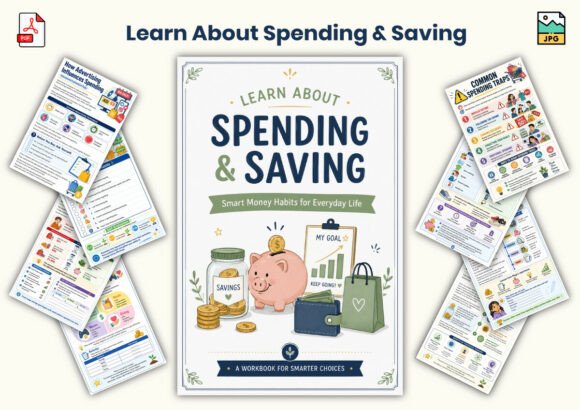
Teaching financial literacy to young learners is one of the most valuable investments a parent, teacher, or mentor can make. A resource like the Learn About Spending Saving workbook provides a solid foundation—31 pages of structured lessons, reflection activities, and practical tools designed to build strong money management skills. However, having a great resource is only half the battle. How you use it determines whether those lessons stick or simply become another completed worksheet that gathers dust.
Adults often approach financial education with the best intentions but fall into predictable traps that undermine the very concepts they are trying to teach. If you are an educator, homeschool parent, tutor, or creator looking to use this workbook effectively, understanding these pitfalls beforehand will save you time, frustration, and ensure your students actually develop lasting financial habits.
The “Set It and Forget It” Trap
The most common mistake adults make is treating a workbook like an independent activity that will teach itself. The Learn About Spending Saving workbook is packed with valuable content—spending awareness, savings goals, budget planning, and smart purchasing decisions—but it is designed to be a springboard for conversation, not a substitute for it.
Handing a child the 31-page workbook and expecting them to absorb financial literacy on their own is like giving someone a map of a city and expecting them to know the culture. The map helps, but the conversation, the guided tour, and the real-world application are what create understanding. The “Reflection Pages” and “Action Plans” included in the workbook are explicitly there to facilitate discussion. When you skip these or treat them as busywork, you lose the deeper learning opportunity.
The better approach: Use each section as a starting point for a family or classroom discussion. After completing the “Needs vs. Wants” worksheet, walk through your own shopping cart together. After the “Budget Planning” page, let them help plan a small real-world budget for a weekend outing. The workbook provides the structure; you provide the context.
Why “Saving” Can Backfire Without a “Why”
Many adults instinctively emphasize saving above all else. “Save your money,” “Don’t spend it all,” “Put it in the bank.” While saving is critical, the Learn About Spending Saving workbook wisely includes sections on Savings Goals and Long-Term Saving Strategies for a reason. Saving without a purpose feels like deprivation. Saving toward a concrete goal is empowering.
A common misunderstanding is that children will naturally understand the value of delayed gratification. In reality, young learners need to see the connection between setting money aside today and achieving something meaningful tomorrow. Without this link, saving can feel arbitrary and joyless.
How to course-correct: When working through the “Savings Goals” section, make it tangible. If a child wants a new video game or a special toy, calculate how much they need, how long it will take to save, and what trade-offs are involved. The “Opportunity Cost” exercises in the workbook are perfect for this. They teach that choosing one thing means giving up another. Use these pages to frame saving as a strategic choice, not a punishment. The goal isn’t just to hoard money—it’s to use it intentionally.
Navigating the Tricky “Needs vs. Wants” Conversation
This is one of the most delicate areas in financial education, and it is where many adults unintentionally teach the wrong lesson. The Learn About Spending Saving workbook includes dedicated worksheets on this topic, but the way you facilitate the conversation matters immensely.
The mistake here is turning it into a lecture or a rigid list of rules. When an adult declares “this is a need” and “this is a want” without allowing debate, children learn to mimic the answers they think you want to hear rather than developing their own critical thinking. Worse, if a child sees you labeling a new phone as a “need” while telling them candy is a “want,” they learn that the exercise is hypocritical.
Turning it into a learning moment: Use the checklists and case examples provided in the workbook as a neutral framework. Ask open-ended questions. “Why do you think this item is important? What would happen if we didn’t buy it?” Let them challenge you respectfully. The goal of the “Needs vs. Wants” and “Smart Purchasing Decisions” sections is to build critical awareness, not compliance. When a child can argue convincingly why a purchase has value, they are demonstrating genuine understanding of opportunity cost and prioritization.
Keeping the Lessons Abstract Instead of Concrete
Financial concepts taught in isolation rarely transfer to real life. A child can perfectly complete a budget planning worksheet but still make impulsive, uninformed choices when they have actual money in their hands. The Learn About Spending Saving workbook includes “Tracking Spending Habits” and “Building Positive Money Habits” sections specifically to bridge this gap, yet these are often the pages that get rushed through.
Adults sometimes treat the workbook as a one-time curriculum to be completed and checked off. “We finished the workbook, so now my child knows about money.” This is a mistake. The real learning happens when those worksheets are brought to life in the messy, everyday decisions of spending and saving.
Practical integration: Use the “Tracking Spending Habits” page for an entire month, not just one lesson. Pair the “Smart Purchasing Decisions” checklist with an actual trip to the store, an online shopping cart review, or a birthday money decision. The “Advertising Awareness” section is incredibly powerful when reviewed right before screen time or a trip to the mall. Ask: “How are ads trying to influence what we want?” The workbook becomes a reference guide you return to again and again, not a one-and-done assignment.
Choosing the Wrong Delivery Method for Your Student
This is a practical but often overlooked detail. The Learn About Spending Saving workbook is provided as a PDF File and JPG Files included, in a 6x9 inch print-ready format with a minimal educational style. Adults sometimes make the mistake of simply storing the file away, or printing all 31 pages at once without a plan.
If you are a teacher or tutor using a digital platform, the JPG files are ideal for assigning pages one at a time through Google Classroom or Seesaw. The minimal style reduces visual clutter and helps students focus on the content. If you are a homeschool parent, the print-ready 6x9 size is perfect for a small binder or folder that can travel to appointments or coffee shops. Trying to work from a tiny phone screen or an unorganized stack of loose pages undermines the experience.
A better workflow: Look at the topics covered—Spending Awareness, Savings Goals, Budget Planning, Needs vs Wants, Opportunity Cost, Advertising Awareness—and decide which section is most relevant to your student’s current phase of life. Print that section first. Use it. Master it. Then move on. The workbook is a toolbox, not a single lesson plan. Taking it in digestible chunks prevents overwhelm for both you and the learner.
Underestimating the Power of “Advertising Awareness”
One of the most overlooked sections in financial workbooks for kids is the one on advertising. The Learn About Spending Saving workbook includes a dedicated Advertising Awareness component, and skipping it or treating it lightly is a missed opportunity.
Children are exposed to hundreds of marketing messages daily. If your financial education focuses only on budgets and savings goals but ignores the sophisticated persuasion tactics used by advertisers, you are fighting with one hand tied behind your back. The spending decisions students make are heavily influenced by emotional triggers and social pressure, not just rational needs.
Using it effectively: Don’t just complete the worksheet. Use it as a lens to analyze the world around them. Watch a few commercials together and use the workbook’s framework to deconstruct them. Who is the target audience? What feeling are they selling? Is the product actually as good as it looks? This combination of theoretical knowledge (from the workbook) and practical application (real-world advertising) builds a protective layer of critical thinking that serves children well into adulthood.
Who Is This Really For? Aligning Expectations
It’s important to understand what the Learn About Spending Saving workbook is designed to do and who it serves best. It is a Minimal Educational Workbook Style resource aimed at young learners, ideal for teachers, homeschool families, parents, tutors, and educational content creators. If you are a business owner or creator looking to bundle or resell educational content, this format gives you a clean, professional base to work from.
A mistake some adults make is expecting a glossy, gamified, or overly colorful children’s book. Instead, this workbook takes a straightforward, reflection-based approach. It prioritizes clear thinking over flashy graphics. For parents or teachers who prefer a calm, focused design that doesn’t overstimulate students, this is a strength. For those expecting heavy cartoon illustrations, it may require a shift in perspective. Knowing your own teaching style and your student’s learning needs will help you use the resource effectively from the start.
The Financial Decision-Making Activities and Long-Term Saving Strategies sections are where the workbook truly shines. These are not just simple tracking sheets—they are structured exercises in thinking. When you guide a student through these thoughtfully, you are not just teaching them about money. You are teaching them discipline, foresight, and intentionality.
The end goal is not a completed workbook. It is a child who pauses before a purchase, sets a savings goal naturally, and understands the trade-offs of their choices. Use the Learn About Spending Saving resource as your roadmap, but take the time to walk the path together. Avoid the shortcuts of passive teaching, abstract lessons, and rigid lecturing. The financial habits built today will shape the adults they become tomorrow.