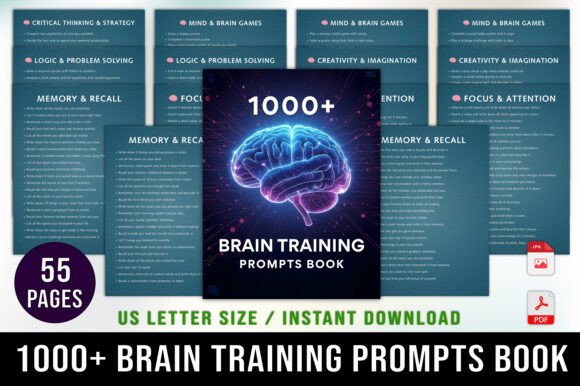
1000 Brain Training Prompts Book: Daily Mental Fitness
If you have ever wished for a simple, structured way to keep your mind sharp without needing apps or expensive programs, you are not alone. The 1000 Brain Training Prompts Book offers exactly that: a collection of daily mental exercises designed to strengthen memory, focus, logic, creativity, and critical thinking. It is not a complicated system or a quick fix. It is a practical resource you can open whenever you want to give your brain a purposeful workout. Whether you are a busy professional, a creative hobbyist, or someone who just wants to stay mentally agile, this book adapts to your needs without demanding much time or effort.
What Makes This Book Different from Other Brain Training Options
Many brain training tools rely on digital platforms, subscriptions, or timed challenges that can feel stressful rather than helpful. This book takes a different approach. It gives you 1,000 structured prompts across five key cognitive areas: memory recall, focus and attention, logic and problem-solving, creativity and imagination, and critical thinking. Each prompt is self-contained, so you can start anywhere and go at your own pace. The format is straightforward—you read a prompt, engage with it mentally or on paper, and move on. There is no right or wrong answer, only the opportunity to practice thinking in new ways.
For some, the appeal lies in the variety. You might work on a logic puzzle one day and a creativity booster the next. For others, the structure is what matters. The book gives you a clear path forward, which is especially valuable if you are unsure where to begin or tend to skip unstructured mental activities. Because it comes with both editable Canva templates and ready-to-upload PDF files, you can also customize the experience. Print the pages, use them digitally, or adapt them for a group setting. The flexibility means it fits into many different routines.
Beginners Looking for a Gentle Starting Point
If you have never done structured brain training before, you might worry that the exercises will be too hard or too academic. That is not the case here. The prompts are designed to be accessible regardless of your background. You do not need any special knowledge or skills. A beginner might start with a simple memory recall prompt like “List five items you saw on your way to work today” or a focus exercise that asks you to describe a familiar object in detail. These small tasks build confidence and show you that mental training does not have to feel like a test. Over time, you naturally move toward more complex challenges, but the pace is entirely up to you.
For beginners, the ease of use is a major priority. The book does not require setup, instructions, or external tools. You open it, pick a prompt, and engage. The high-quality PDF files are ready to upload or print, so you can start within minutes. The 55 different Canva templates also mean you can customize the look if you prefer a certain layout or want to add your own notes. This low barrier to entry makes it easy to build a daily habit without feeling overwhelmed.
Professionals and Entrepreneurs Seeking Mental Clarity
For professionals—whether you are a marketer, freelancer, or small business owner—mental fatigue is a real challenge. Your days are filled with decisions, deadlines, and constant switching between tasks. The 1000 Brain Training Prompts Book can serve as a short mental reset. A five-minute focus exercise between meetings or a logic challenge during a lunch break can help you regain concentration and approach problems with fresh perspective. The prompts are short enough to fit into a busy schedule, yet meaningful enough to exercise cognitive muscles you may not use in your daily work.
Entrepreneurs, in particular, may value the critical thinking and strategy prompts. These exercises encourage you to examine assumptions, evaluate options, and think several steps ahead—skills that are directly useful when you are planning a product launch, negotiating a deal, or refining your business model. The book does not teach business strategy directly, but it trains the underlying thinking skills that make strategy work. Over time, you may notice that you pause more before reacting, consider alternative angles, and generate ideas more fluidly.
Creators and Hobbyists Who Want to Stretch Their Imagination
If you are a writer, artist, designer, or anyone who works creatively, you know that ideas do not always come on demand. The creativity and imagination boosters in this book are designed to help you generate new connections and break out of routine thinking. A prompt like “Combine two unrelated objects into a single useful invention” or “Describe a familiar scene from the perspective of an insect” pushes you to think differently. These exercises are not about finding the “correct” answer; they are about exploring possibilities. For creators, that freedom is valuable. It can help you overcome creative blocks, develop new concepts, or simply warm up before a project.
Hobbyists may appreciate the variety and replayability of the prompts. With 1,000 exercises, you can return to the book again and again without repeating the same activity too soon. The prompts are structured but open-ended, so even if you revisit a similar type of exercise later, your response will be different based on your current mood, experiences, and context. That keeps the practice fresh and engaging over the long term.
Educators and Group Facilitators
Teachers, tutors, and workshop leaders often look for resources that are easy to adapt for different age groups and skill levels. This book fits that need well. The prompts are written in clear, simple language, and they do not rely on specialized knowledge. An educator might use a focus exercise to settle a class before a lesson, a logic challenge as a warm-up activity, or a creativity prompt for a group brainstorming session. The editable Canva templates make it easy to adjust the formatting, add instructions, or create worksheets that match a specific curriculum or theme.
For educators, flexibility and presentation matter. The 55 different templates give you options to create handouts, slides, or digital assignments. You can also select prompts that align with the skills you want to emphasize—whether that is analytical thinking, verbal reasoning, or visual imagination. The book saves time because you do not have to design exercises from scratch. You can pick and choose what fits your group and adapt as needed.
Quality and Depth of the Prompts
Not all brain training resources offer the same level of thoughtfulness. Some rely on repetitive puzzles that become boring quickly. Others are too abstract to apply to everyday life. The 1000 Brain Training Prompts Book strikes a balance. The prompts are varied enough to challenge different cognitive skills, yet grounded in real-world scenarios. A memory prompt might ask you to recall details from a recent conversation, which has practical value in both personal and professional settings. A logic challenge might present a scenario that requires step-by-step reasoning, similar to what you face when planning a project or solving a problem at work. This connection to real life makes the exercises feel meaningful rather than abstract.
Long-Term Usefulness
One of the strongest features of this book is its longevity. With 1,000 prompts, you can use it daily for nearly three years without repeating an exercise. Even after that, you can revisit prompts and engage with them differently. Your responses will change as your thinking skills evolve, so the book remains useful long after the first pass. For someone who values consistency and gradual improvement, this is a significant advantage. You do not need to buy a new book every month or search for fresh content online. Everything you need is already there.
Cost and Accessibility
Compared to subscription-based brain training apps or live workshops, this book is a one-time investment. The package includes high-quality ready-to-upload PDF files and editable Canva templates, so you can use it in whatever format suits you best. Print it, keep it on your tablet, or share it with others. The page size of 8.5×11 inches is standard and easy to handle. For small business owners or educators who need to provide materials for multiple people, the ability to print or share digitally without additional cost is a practical benefit.
How to Know If This Book Is Right for You
If you are someone who enjoys structured activities but does not want a rigid schedule, this book fits well. You can use it daily, weekly, or whenever you feel like exercising your mind. It does not require a time commitment, a specific environment, or prior experience. The prompts work equally well as a morning mental warm-up, a break-time reset, or an evening wind-down activity.
If you are more advanced in brain training, you may still find value here. The variety of prompts across different domains means you can focus on areas you want to strengthen. A person who is already good at logic puzzles might choose to spend more time on creativity or memory exercises. The book does not force a sequence, so you can tailor your practice to your own goals. The critical thinking and strategy prompts, in particular, offer depth that even experienced users will appreciate.
For those who prefer digital over physical, the editable Canva templates make this book easy to integrate into a digital workflow. You can fill in prompts on your device, save your responses, and revisit them later. The ready-to-upload PDF files are convenient for printing or sharing with a group. This flexibility ensures that the book fits into your existing habits rather than requiring you to change them.
Final Thoughts on Building a Daily Mental Fitness Habit
The 1000 Brain Training Prompts Book is not a magic solution that will instantly make you smarter or more creative. What it does is provide a consistent, low-pressure way to practice the mental skills that matter in everyday life. Whether you are a beginner taking your first steps toward cognitive fitness, a professional looking for sharper focus, a creator seeking fresh ideas, or an educator wanting to engage your students, the book offers a practical path forward. The key is simply to start—one prompt at a time. Over days and weeks, those small efforts add up to real improvement. And because the book is built for the long haul, you can keep going as long as you like.
Your goals, skill level, and preferred style will determine how you use it, but the structure is designed to adapt. If you have been looking for a straightforward, durable, and flexible brain training resource, this book is worth exploring. It puts the power of daily mental exercise in your hands, without any extra fuss.